Thursday, October 30, 2014

When do you just let go?


This month I learned, again, that I hate fighting.  My training tells me that conflict can lead to strengthened relationships and sustainable outcomes. I need frequent reminders though since my instinct is to leave, hide, and ignore. 

So, here’s my question, when is the time to stick with a conflict and have it out, and when do you just let go?

The end of September my milk cow, Molly, had her calf.  Molly had been on vacation for a few months and at this juncture she strongly stated her preference of being left alone with her darling newborn in their idyllic pasture.  On the other hand, I knew that if I wanted to milk Molly at all during this lactation I would need to start right away.  Thus commenced battle royal.  Below is a cartoon showing the lead-up to the first milking:

Yes, go ahead and laugh! Do you see why I’m asking when to let go?!

In all seriousness, I ask myself this question every time I am in conflict with someone. I can’t pretend to have answers because I think I will be asking this question for a very long time but here are some things I’ve been thinking about:
·      Letting go isn’t necessarily giving in.  We can choose to let go of the fight in order to look for a more creative solution.
Fighting isn’t the only option; in this case letting go isn’t the easy way out!
·      At times choosing not to engage can do a great deal of damage.
I think we sometimes forget that conflict is not something to be extinguished at all cost but rather a time of great energy and creativity.  The world, in case you hadn’t noticed, is not a perfect place and conflict happens when we try to work on that.
·      There are times to choose not to engage.
I relearned what it feels like to be angry this month.  It took something petty - watching the work of a half an hour seep into the dirt because of Molly’s well-aimed kick.  Though anger can give me the energy to continue interacting, I dislike the way I behave when my anger is red hot.  It’s more helpful for me to pet the cat or admire the sunset before I find a way to tell Miss Molly that such behavior gets us no where.

And perhaps what I’ve found most helpful, when you wonder whether to give up on the struggle ask yourself two questions: How important is this relationship to me? and How important is this issue to me? 

What do you think?  When do you forge through the hard spots and when do you just let go?


P.S. I’m sure you’re all dying to know that Molly and I have worked through our differences enough to get through a milking with tolerable ease.  She hasn’t tried to run away from me after turning around mid-caper to find me face planted in a grass clump.  Though she still dances around occasionally I am learning to be a better dance partner and the bucket usually remains unscathed. 


Tuesday, September 30, 2014

Learning the Art


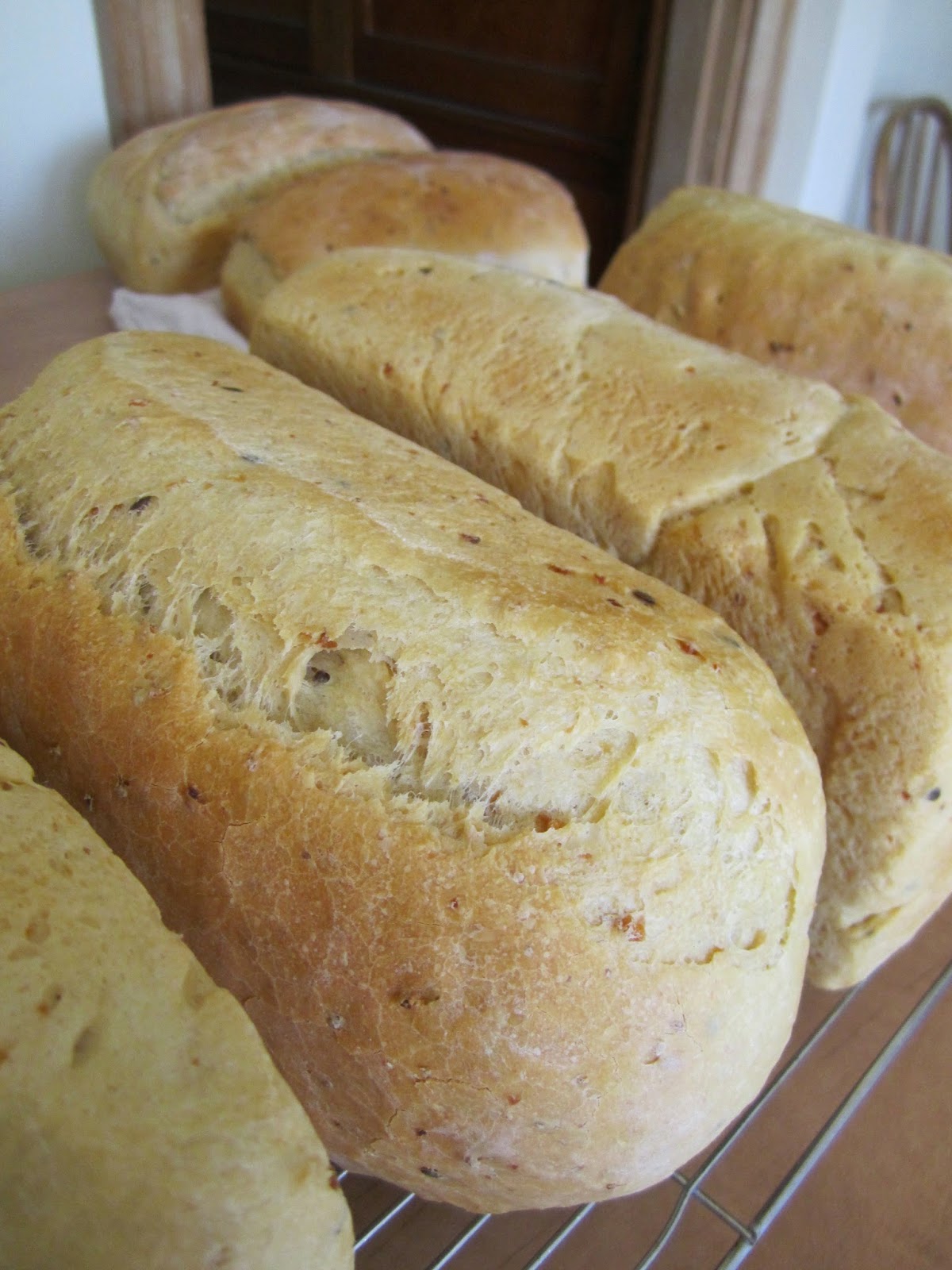
When I make bread I usually follow my Grandma’s recipe.   Likewise when I make cheese I closely follow directions.  Even so, I have spent considerable time over the last several years learning these skills.  My poor family ate many loaves of flat, dense bread, and cheese failures dubbed “unidentifiable white mass.” 
 
So what’s the deal?  Am I just below average at following instructions? Perhaps, but I like to think that the learning process took time because these skills, like many others, are both theory and art. 

Here’s an example:  At some point most cheese recipes tell you to heat the curd. What they neglect to tell you is that if you heat the curd too fast, it breaks down creating paste instead of hard or semi hard cheese. Heat no more than two degrees every five minutes, theory says.  I’m learning the art of recognizing quickly approaching cheese failure.

Or take bread: Recipes usually tell you about how much flour is needed, say 6-8 cups.  Yet if you dump that much flour in at once you have a mess!  Experienced bread makers usually don’t measure their flour.  They add in a little at a time, let their bread rest, and stop adding flour when it feels right. 

I think that the act of doing conflict well in order to further peace shares this trait of being, at it’s best, influenced by both theory and art.

When my colleagues and I at Common Ground Conciliation Services Inc. conduct trainings about conflict much of what we offer is theory gleaned from social science:

We can tell you about the conflict escalation scale as well as ways to increase or decrease it.

We can tell you about the incredible power of real listening and some tips of what that might look like.

We can tell you about different styles or ways of doing conflict and times when each method may be appropriate.

And the list goes on.

This theory is valuable information; yet knowing it isn’t the same as living so as to further peace in the world around you. I can’t say I am a cheese maker just because I know the theory of how cheese is made. 

Conflict theory at it’s best isn’t something we can put on or put off depending on what we think will benefit us most.  To be most effective conflict theory must cease being theory, and become a part of who we are.

Even though the outcome of what I make sometimes disappoints me I am a baker and cheese maker.  With every batch I try to do just a little better, to learn more of the art.

Working toward peace through intentional everyday interactions is the same way. We are never going to arrive because no conflict is ever the same as the last. However, if we keep practicing despite our failures, we can always get better. And, isn’t that part of the fun?

Friday, August 29, 2014

Walk beside me!


My family names just about everything.  We have tractors Bill, Gene, Joe, and Lewis. We’ve named fields: Tennessee, Rhode Island, the Bayou… I sometimes name in haste and repent in leisure though. Take my cat Gabby, for instance.  I named her too early in our friendship.  It turns out she isn’t much of a Gabby; she much prefers being called Nellie.

Naming goes beyond dishing out handles for ease of conversation though.  Naming requires awareness. We need self-awareness to name our own needs, emotions, and trigger behaviors.  Likewise, by listening attentively we can create a safe place for others to name their needs and emotions too. This awareness helps us diffuse tension and find ways to move forward.

Here are two anecdotes to show you what I mean:

Self-awareness: I play the fiddle in our little family band and we worked up a few old ballad songs this summer. These songs have been sung in our family for generations and while we’ve written the words down, we’ve always learned the music by ear.  I can sing these songs just fine, but after working for months to learn the simple tunes on the fiddle they still wouldn’t stick.  As performance day drew closer and the pressure mounted I was just about ready to throw in the towel.  It took several tries, some incorrect naming, to finally pin down the problem.  Being a visual learner, every time I picked up my fiddle to play those tunes I had to RE-learn them before I could make the notes sound like the tune in my head.  Especially because of the time constraint, I needed the music in front of me before could I get to work with some hope of success.
Have you ever experienced the relief of putting words to some emotion, or need? It’s like a sigh or relaxation, a step in a helpful direction.

Other-awareness: It seems most respectful to those I live with and interact with to illustrate this with another animal story.  The other day the cattle came from the pasture to the corral.  My cow, Miss Molly was among them.  Since she is on her several month vacation our interaction has changed from twice daily to perhaps weekly.  As I peeled back the husk from the ear of corn I held I called for Molly and out she came, separating herself from the herd. This was only possible because of the “naming” I had done earlier in our friendship to gain her trust.  I noticed when she was hungry. I observed that she likes the tuft of hair on top of her head scratched.  She loves third cutting hay, and doesn’t care much for grain. Finally, what took me the longest to name accurately, she hates to be chased or led but will usually walk beside me in a most friendly manner wherever I want her to go.
Naming in other-awareness means noticing what others like and dislike, their triggers, what makes them tick... And then, when possible, behaving in such a way as to build their trust.  This is a gift we can give to each other since many people crave being known.

Look for the power of naming; the act of noticing and becoming aware.

Friday, May 30, 2014

Legacy


Across my dining room table sprawl large pieces of poster board littered with rulers, pencils, and open books of family history. You see, I’m drawing a family genogram of rather large proportions, and in the process I am learning much about myself through the mirror of my ancestors. 

This year our family farm turns 100 years old, and come the end of June we’re hosting a big bash with people coming from far and near.  Part of the day will be a multi-branch family reunion.  Of course, when you get cousins and second cousins from various family lines, those whom we call family can hardly be expected to know each other.  Thus the need for a family tree: a visual of how we are all connected to each other and to this place.

As I draw and label I recognize names and remember stories.  There’s Magdalena who went by Mattie, Maggie, and Molly.  So that’s where my family’s propensity for nicknaming came from! Great Granddad played the mandolin and fiddle, and many in the family sang with voices mixing in beautiful harmony.  It’s no wonder music seems as necessary as breath.  If my ancestors could look at a section of desert, envision making a living there, and actually pull it off, there must be a healthy streak of optimism, persistence, and stubbornness!   

We learn from our families.  We test behavior on those closest to us and hear what actions are appropriate.  As children we mimic our parents.  And of course, there are genetics.  Because of a combination of inheriting and learning, family stories can give us hints for self-awareness. 

We can look for patterns in our family history for many aspects of life, including how we engage with others during conflict or other times of stress.

In your family culture what is the most appropriate way of dealing with disagreement? 

What fights, breaks in relationship, or ruptures have happened in your family history?  How does that affect your response to relational crisis? 

When you hear family stories, in which of your ancestors do you see yourself most often?